
Maximizing return on investment of industrial facilities: Five Questions with Michael Schmidt
Maximizing return on investment of industrial facilities: 5 Questions with Michael Schmidt
Recent Perspectives


In today’s high-volume food distribution centers, operational efficiency increasingly starts with the building itself. When the program, building structure, and systems are thoughtfully integrated, a facility can minimize energy use, reduce labor strain, and streamline product flow while preserving food quality. The most successful warehouses are no longer designed as neutral shells but as purpose-built environments aligned with refrigeration demands, material handling strategies, and future automation.
At the same time, the definition of efficiency has expanded beyond throughput and cost. Owners are recognizing that employee experience, safety, flexibility and resilience are inseparable from performance. From daylight-filled break areas and safer traffic separation to infrastructure that supports future technology and withstands climate disruptions, building design is becoming a strategic tool. In this article, Michael Schmidt, LEO A DALY’s industrial market sector leader, explores how integrated, human-centered, and forward-looking design choices can improve day-to-day operations and prepare distribution facilities for the demands of tomorrow.
Q: How can the design of a building increase operational efficiency?
A: Efficient cold storage design improves operations by optimizing product flow, correct temperature zoning, and storage density to reduce handling, travel time, and energy use while increasing throughput. The building design needs to align with refrigeration, material handling, and automation readiness. Efficient layouts lower labor needs and operating costs; it boosts productivity and preserves product integrity as volumes scale.
The most efficient cold storage facilities are designed by treating the building, refrigeration and material handling systems as a single integrated unit rather than independent elements. This approach starts with a building layout that lowers refrigeration loads through optimized clear heights, continuous insulation, and strong vapor control and airtight construction. Inside the facility, aisle widths, rack layouts and dock locations are planned to work seamlessly with material handling equipment and automation, both available currently and future technology. Structural elements such as column spacing, slabs and roofs should be coordinated early to support airflow, equipment loads and future expansions without major retrofits. Thermal zoning, buffer spaces and well-placed refrigerated docks can help keep temperatures stable, reduce air infiltration and protect product quality.
Q: How do you address employee retention in your designs?

The break room at a Kroger facility in Cincinnati, Ohio, is light, airy and easily accessible to employees.
A:Traditional food, manufacturing, and distribution warehouse designs tend to prioritize space utilization, linear flow, and labor flexibility and do not take into account the employee. These facilities tend to have long travel paths in cold zones, wet floors, areas with poor daylighting, and limited recovery spaces. The high‑density, labor‑intensive job requirements often drive burnout during peak periods through excessive walking, noise, and physical demands. As we design for the future of warehousing, the design should balance the needs of the facility with the employee environments.
At one large food service retailer in the southeast U.S., the break room was positioned such that employees didn’t have time to return to their lockers during breaks, or to eat lunch. This impacted morale and job satisfaction. To solve this, we:
Moved breakrooms close to the employee work areas and created spaces for breaks at the various dock areas.
Located the break rooms on an exterior wall for daylight opportunities.
Provided outdoor seating near break areas.
Split up the primary locker area into two smaller locker areas at each end of the warehouse.
Placed the time clocks at the specific work areas for easy access and to allow supervisors to have visual contact with employee shift accountability.
Q: What are your strategies to ensure industrial facilities promote safety in operations?
A: Future warehouse designs should foster employee retention by shrinking freezer exposure through zoning and automation, improving thermal comfort with vestibules and spot conditioning, and reinforcing safety and pride with the employees. We need to emphasize predictable equipment travel and employee travel flows, visual way finding management, and cross‑training zones that reduce stress and signal career progression. The vision in laying out these buildings needs to include employees as long‑term assets — using space programming, ergonomics, safety, and comfort as strategic tools to reduce fatigue, improve predictability, and keep experienced employees on the floor longer.
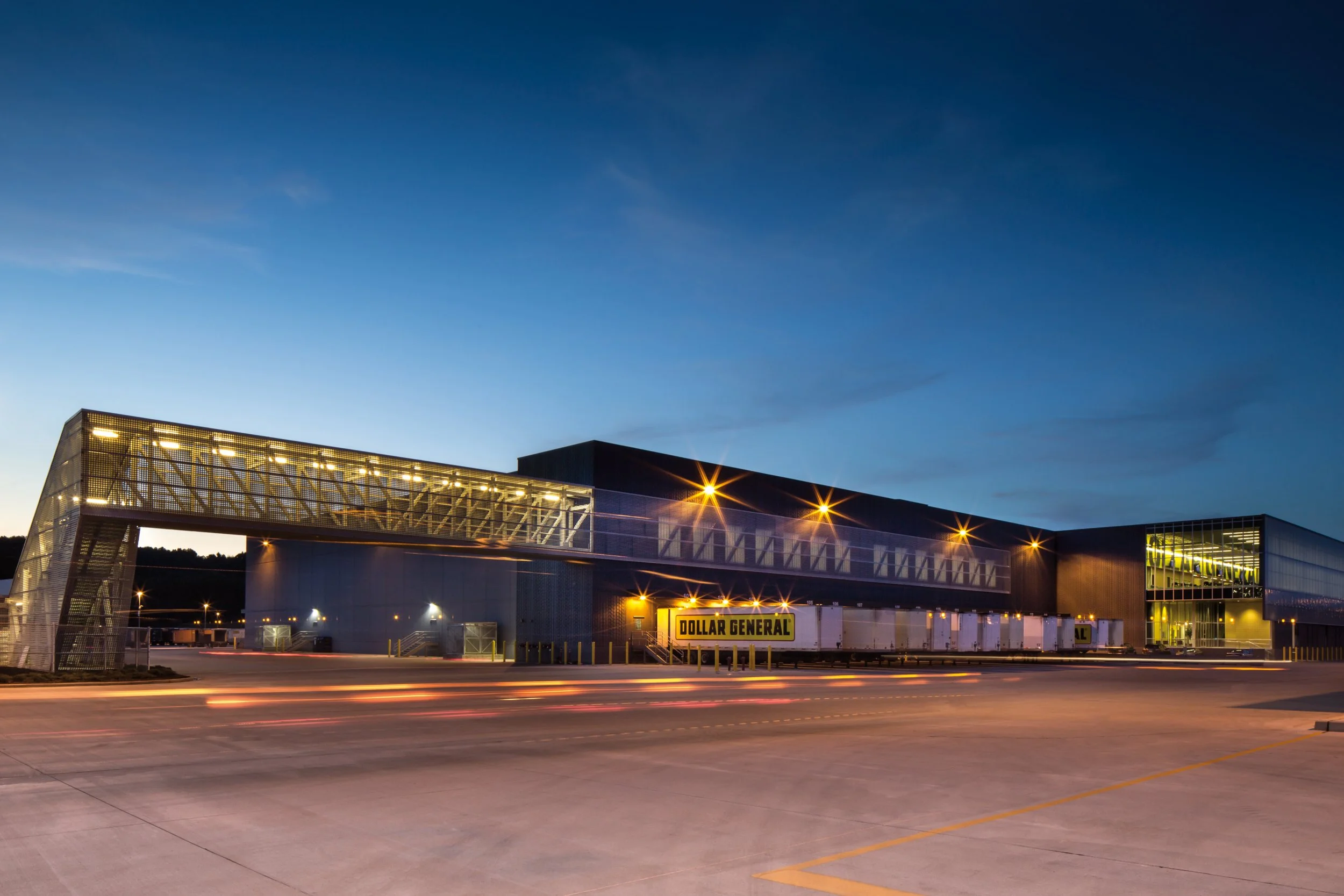
At a Dollar General facility in Alabama, our design team interviewed stakeholders and department heads to help us understand some of the concerns that needed to be addressed in their new facility. One primary concern that was highlighted is employee circulation within the facility posed a safety risk. The solution — one we’ve implemented at multiple facilities — is an elevated walkway to separate foot traffic from forklifts. The employees ascend via a stairwell to an elevated walkway. This walkway is connected to the second-floor employee areas and offices. The walkway is located on the exterior wall above the docks and is fully enclosed and mechanically conditioned.
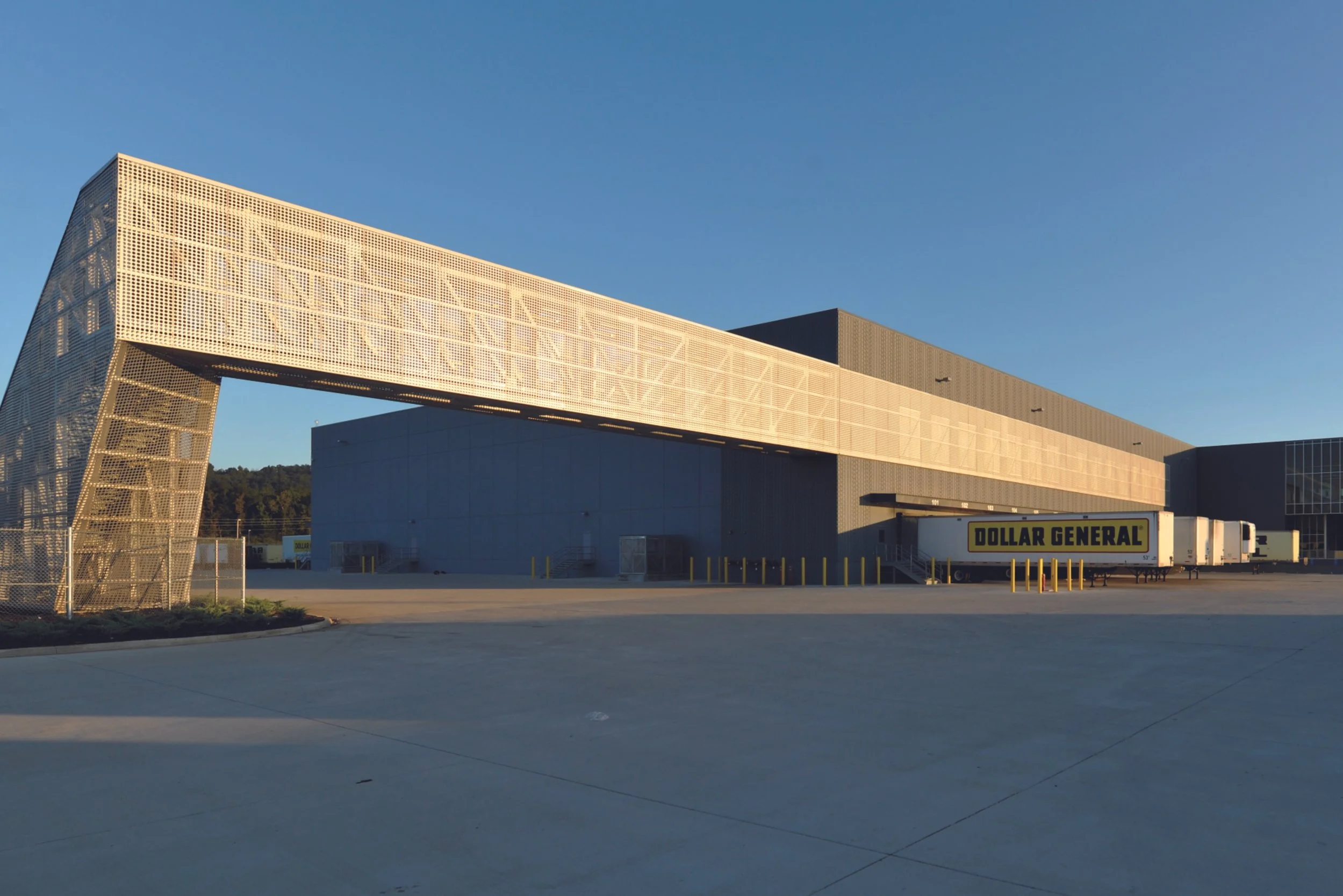
The Dollar General distribution center in Bessemer, Alabama, features an elevated walkway to separate foot traffic from shipping and receiving dock traffic.
Q: How do you design flexible buildings that are equipped for the needs of tomorrow?
A: Planning for building flexibility means that customer growth, a change of product demand or even an unexpected global event can be more easily accommodated when needed. Designing for seamless change means less retrofitting when the needs is required. This is a combination of the structure of the building, new technology, and the storage area racking within it.
Networking/logistics: Data infrastructure plays a foundational role in designing cold storage warehouses for flexibility and long‑term relevance. It allows facilities to evolve with automation and operational challenges. A warehouse must be designed with robust, scalable data pathways including redundant fiber infrastructure, network drops to rack aisles and dock positions, and provide protected environments for servers and controls. As the needs of tomorrow change, having this planned enables seamless integration of warehouse management systems, warehouse control systems, refrigeration monitoring and building management systems without invasive retrofits or system shut down.
Physical flexibility: The way a building is designedcanleave room fora shift in product, layout or volume of work. For example, the structural grid can be designed to support multiple equipment layouts, rather than the first planned iteration. If the facility might convert to refrigeration in the future, the thermal envelope should be designed to support wider temperature ranges and slab designs should anticipate freezer temperature and product loads.
Electricity:Future developments in equipment and technology could lead to major shifts in energy usage for industrial facilities. Owners can more easily take advantage of future opportunities by designing and implementing infrastructure sized for future loads, allocated yard space for future equipment such as chillers, space for future photovoltaic panels, batteries, backup generation and thermal storage.
Q: Distribution centers need to be able to withstand climate or other disasters. How do you ensure a facility is prepared for anything?
A: Food distribution centers are becoming critical lifelines as climate-driven storms grow more frequent and severe. This article highlights how the resilient, LEO A DALY–designed Cheney Bros. Distribution Center in Florida withstood multiple hurricanes while continuing operations and supporting emergency responders. Click here to read how resilient design is shaping the future of storm-hardened food distribution facilities.
Distribution centers can be prepared for climate and other disasters by taking a layered, risk‑based approach that combines resilient facility design, protected and redundant utilities, flexible operations, and strong emergency planning. This includes designing buildings and critical systems to withstand site‑specific hazards, ensuring power and data continuity, training people with clear response roles, and building network flexibility through alternate sites and inventory strategies. When physical resilience, operational adaptability, and recovery planning work together, a facility not only survives disruptions but returns to full operation faster, protecting both people and the supply chain.
About the authors

Michael Schmidt
Market Sector Leader, Industrial
Michael Schmidt, AIA, NCARB, serves as market sector leader for LEO A DALY’s industrial practice. With more than 27 years of experience in architectural design, he is highly skilled in leading multi-disciplinary teams and managing large-scale projects. Michael’s background includes significant expertise in food distribution and manufacturing, as well as retail and commercial space planning. His passion for innovative, resilient design is reflected in his work on major distribution centers, cold storage facilities, and complex industrial projects across the country. He holds a master’s degree of architecture from Clemson University.