
Planning the critical access care center of the future: Five questions with Larry Crane
Flexibility is key in rural health care design

Recent Perspectives




Rural critical access hospitals are being asked to do more with fewer resources, and thoughtful planning is becoming one of their strongest tools. Facilities that can flex — spaces that shift between med-surg and acute care, departments designed to expand without major disruption, and layouts that keep travel distances manageable as buildings grow — are better equipped to handle changing community needs.
In this interview, LEO A DALY Healthcare Market Sector Leader Larry Crane, ACHA, AIA, NCARB, LEED AP, shares how flexibility and creativity in design can help rural hospitals increase operational efficiency and ultimately provide better patient care.
1. With so many challenges facing rural critical access care centers (funding, staffing shortages and more), how can planning and design ensure an efficient and effective facility?
Flexibility is essential for the success of rural critical access care centers, especially as these facilities face ongoing challenges such as limited funding, staffing shortages, and unpredictable changes in healthcare delivery and reimbursement. Rural hospitals are often required to provide a wide range of services to their communities, but they rarely have the space or resources to dedicate separate areas for every function. Instead, planning and design should focus on creating adaptable spaces that can be repurposed or adjusted as needs evolve. For example, modular headwalls and infrastructure upgrades can allow patient rooms to shift from medical-surgical to acute care in minutes, while conference rooms or storage areas can be converted into clinical spaces as demand changes. This approach ensures that facilities are prepared to accommodate new specialties, respond to community health needs, and adapt to changes in reimbursement models without costly renovations or disruptions. Additionally, efficient design can enhance reimbursement opportunities by maximizing the usable, billable space within a facility.
Additionally, thoughtful planning for future growth is critical. High-cost areas such as surgery and radiology should be located on the building’s perimeter, making it easier to expand these services as the community’s needs grow or neighboring hospitals close. Inpatient units should be designed to allow for manageable travel distances even as the facility expands. By prioritizing flexibility and strategic placement of key departments, rural healthcare facilities can remain efficient, effective, and resilient—ready to meet the evolving needs of their communities while maximizing operational and financial sustainability.
2. Behavioral health needs are growing everywhere. How can design best serve the specific needs of rural areas?
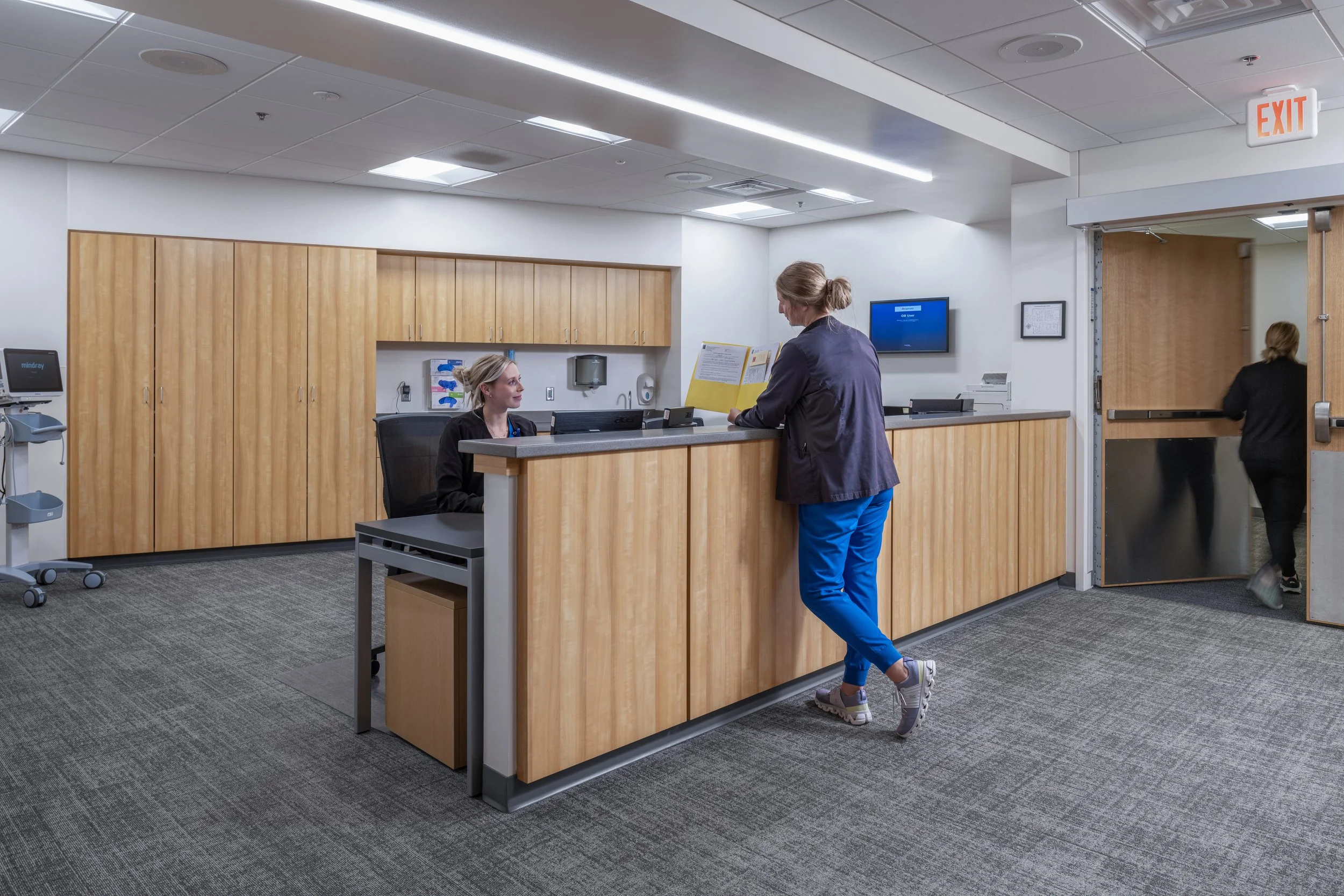
The Boone County Health Center in Nebraska has a nurse’s station located between two wings, creating efficiencies for nurses who support both.
Behavioral health needs are rising everywhere, and rural communities feel that pressure acutely. The best way design can support patients and providers is by integrating behavioral health thinking into every part of patient care, a design consideration that touches every department. In rural areas, these patients are your neighbors.
Key considerations:
Safety: Both patients and staff deserve environments that feel safe and are safe. This includes expanding ligature resistant zones, enabling both direct and passive observation and designing circulation patterns that separate patient and staff flows where appropriate.
Dignity: Trauma informed design is essential in any health environment, especially in rural communities where personal relationships and community ties run deep. Destigmatization must remain top of mind. Design should communicate value, worth, and respect for every patient. Environmental cues — natural light, biophilic elements, noise reduction strategies, outdoor access and adaptable spaces — help refocus patients toward calm, supporting both sensory and cognitive healing. Providing choices, whether for privacy or group engagement, reinforces autonomy and trust.
Access: Behavioral health design must also consider access to crisis management resources, tele‑health, counseling, and financial support. In rural settings, where services may be geographically dispersed, the physical environment can act as a bridge, making it easier for patients to connect with the help they need.
Staff efficiency: In places where recruiting and retention is a challenge, creating efficient spaces can ease staffing shortfalls by increasing utilization and creating spaces where staff can perform their jobs more efficiently.
3. How can design address the entire continuum of care? What challenges and solutions do you find specific to critical access care centers?
One of the main challenges to continuum of care in rural communities is logistics. When it takes long trips to visit different providers, care becomes more difficult and disjointed.
Facility design that seamlessly integrates technology — such as telehealth and telemedicine — into the building’s infrastructure is transforming rural healthcare by expanding access to care and alleviating provider shortages. By equipping patient rooms, emergency departments, and even existing spaces with telehealth capabilities, facilities can connect patients with specialists remotely, reducing the need for long-distance travel. For example, high-speed fiber optic lines and dedicated IT pathways ensure secure, high-quality video consultations and the transmission of medical imagery, while server rooms and network layouts are planned with flexibility and future growth in mind. In some cases, advanced technologies like robotic surgery allow physicians to perform procedures remotely, and simulation labs equipped with cameras enable real-time guidance from experts across the globe.
These innovations not only enhance the quality of care but also help rural residents receive treatment close to home, supporting both community health and convenience. Similarly, this is another reason to incorporate flexibility into spaces. A single department may need to support infusions, dialysis, and cancer care, each with its own clinical and infection‑control requirements. That’s where early planning around HVAC and environmental controls becomes essential. These services often require different air‑change rates, pressure relationships, filtration levels, and temperature needs, and those differences have a direct impact on patient safety. Early planning and appropriate infection control design allows an area intended for one use to be able to be flexed into, say, a cancer unit, without an overhaul of the entire facility.
4. How can design make it easier (and less stressful) for patients to navigate their care?
One small design tweak that has major benefits for patients is a common point of entry. This means that no matter the healthcare need, patients enter the building through one door and check-in at one desk. The receptionist then directs them to the appropriate department, from the emergency room to physical therapy.
The more traditional layout is that different departments have separate entry points, often aligned with the insurance billing for the type of healthcare. This makes sense to the people who work at healthcare centers, but often it leads to confusion and stress among patients. I almost always advocate for a common entry point, and clients universally report positive reception to that move.
We also recommend looking for other ways for patients to have some control over their environment. The temperature of their room, what they watch, when they eat, access to their own records — more control over these environments makes for calmer and more engaged patients and caretakers.
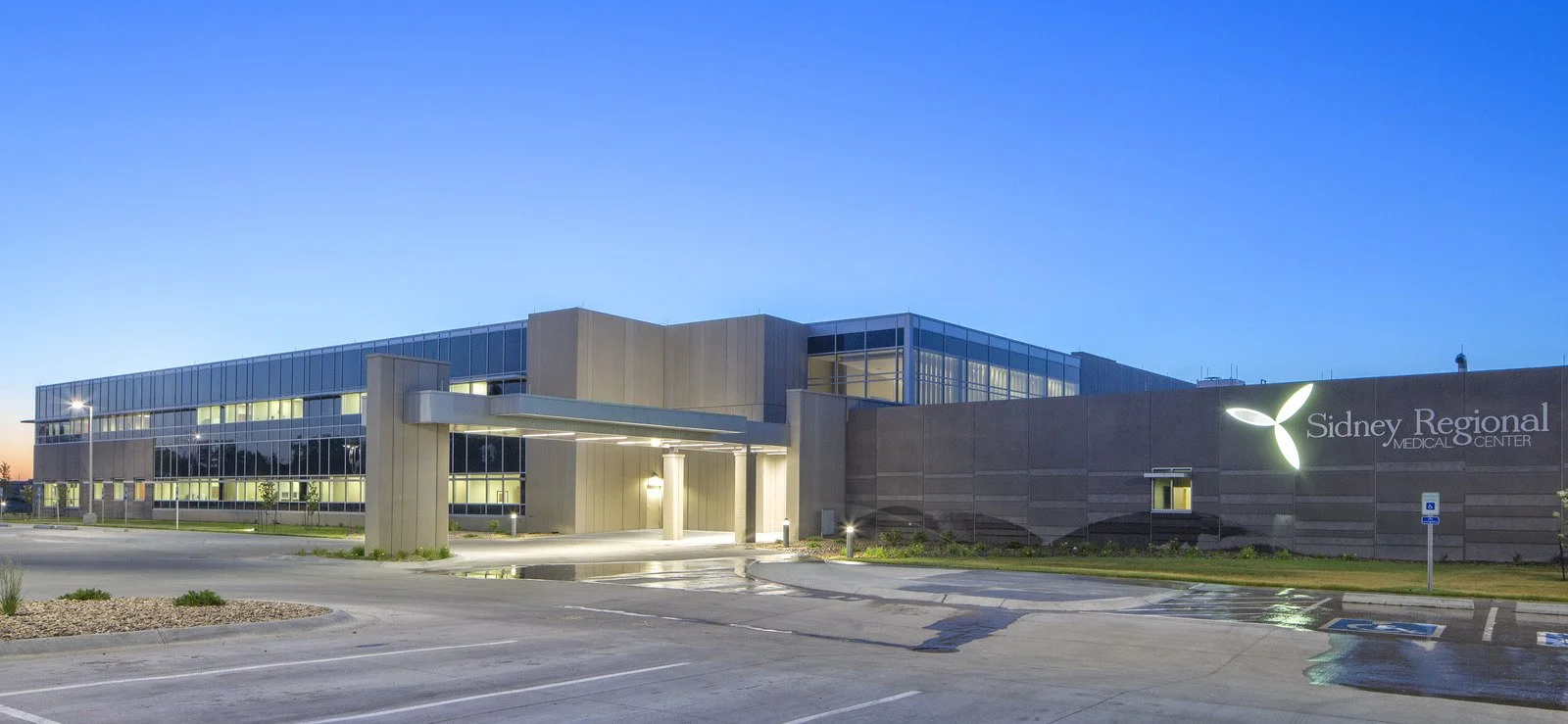
The Sidney Regional Medical Center uses a single access point.
5. Are there design strategies to address supply chain issues?
Absolutely. Healthcare centers can function as their own distribution centers, cutting out the middleman and ensuring they have the equipment they need.
Avera Health realized during the pandemic that supply shortages were putting their entire system at risk, so they made the decision to take control of their own supply chain. They built a centralized warehouse, standardized the products used across their facilities, and shifted to electronic tracking and ordering. By cutting out middlemen and managing inventory themselves, they moved from a 3% operating loss to a 10% positive margin within a year.
A key part of making this work is understanding real demand instead of overordering “just in case.” Some systems invest in advanced tools like robotic delivery, but rural hospitals can still make meaningful gains by tightening their tracking and storage strategies. Centralizing most supplies while keeping only the essentials at the bedside reduces waste and saves staff time. The same applies to medications: knowing exactly where high cost, short shelf life drugs are stored prevents loss and improves access. Whether through shared purchasing groups or smarter internal organization, rural providers can strengthen their supply resilience with practical, informed planning.
Even smaller rural systems can benefit from taking more ownership of their materials management—whether through on‑site or off‑site storage, better data on what they actually use, or forming buying networks with neighboring hospitals.
About the authors

Larry Crane, , ACHA, AIA, NCARB, LEED AP
Market Sector Leader- Healthcare
With over 25 years of dedicated experience in healthcare design and more than 33 years in the industry, Larry Crane is recognized for his collaborative and approachable leadership style. He is known for fostering meaningful engagement with clients, stakeholders, and design teams, guiding the discovery of project goals and the development of consensus-driven solutions. Crane’s expertise spans community hospitals, clinics, and complex facilities, particularly across the Midwest.
Interested in learning more about how to create efficient, flexible spaces for rural health facilities? Contact Larry Crane or visit our healthcare page.