
Insights: UCLA’s hybrid operating room
Health and wellness market sector leader Sarvine Ashkan explains how thoughtful design advances performance, safety and workflow in complex surgical environments
Recent Perspectives



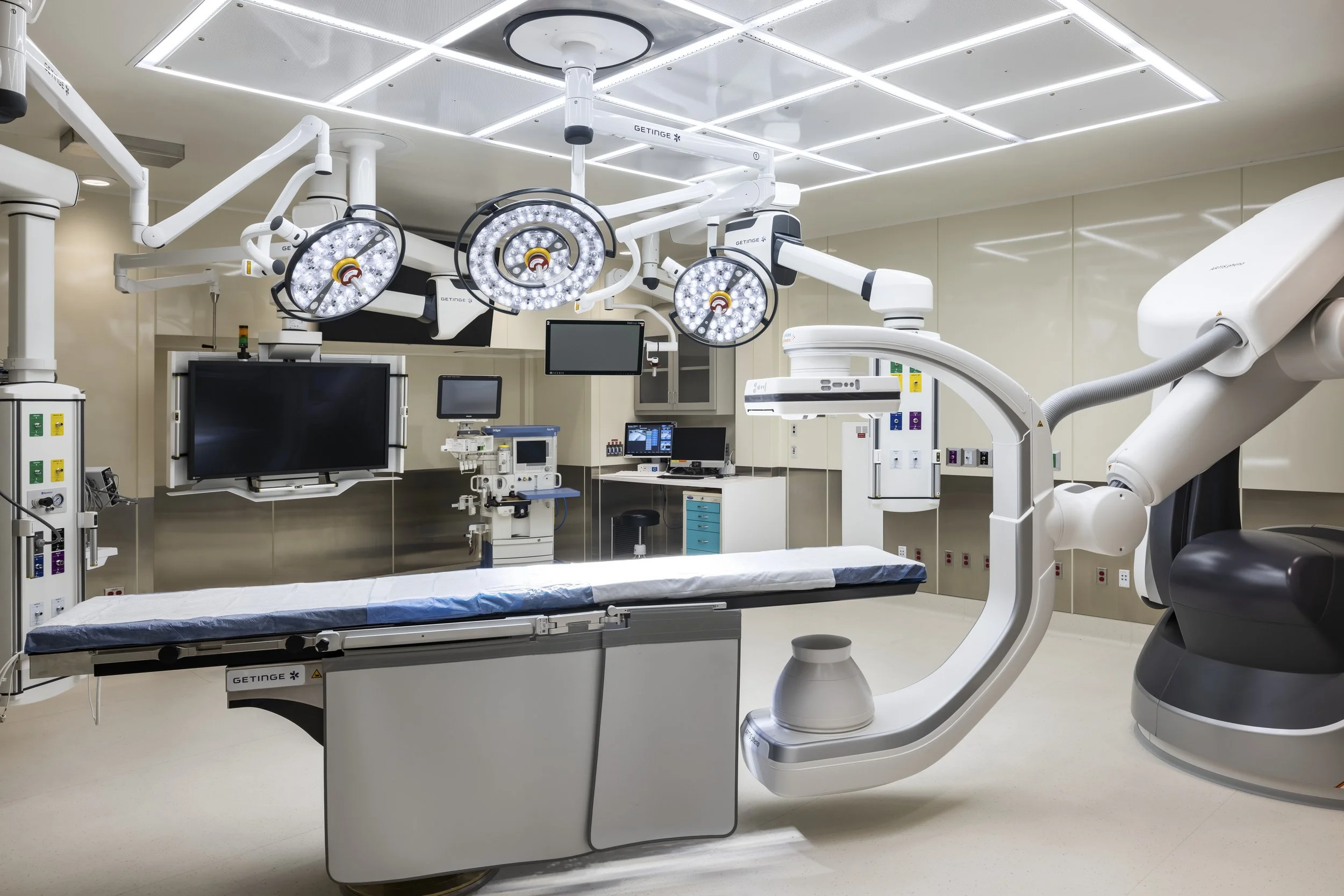
Hybrid operating rooms combine advanced imaging, surgical flexibility, and multidisciplinary workflows. Because these rooms are among the most complex spaces in a hospital, understanding how they perform after occupancy is essential.
During the 2024 Healthcare Facilities Symposium and Expo, Sarvine Ashkan presented findings from a post-occupancy evaluation focused on a newly completed hybrid OR. The assessment included staff surveys, workflow shadowing and interviews with clinical users to understand what functioned well and where future improvements could strengthen surgical environments.
At UCLA Ronald Reagan Medical Center, LEO A DALY partnered with UCLA Health to evaluate the hospital’s first hybrid OR through a detailed post-occupancy study, 8 months after full occupancy.
What the surveys revealed
Online surveys were distributed among the Surgical team with about 20 questions.
The results were analyzed and put into various graphs for comparison.
Staff feedback showed strong performance in several operational areas. Most respondents reported that the hybrid OR is well connected to the sterile core, staff lounge, pre-op and PACU. Circulation around surgical lights and booms scored high, and room pressure was consistently maintained.
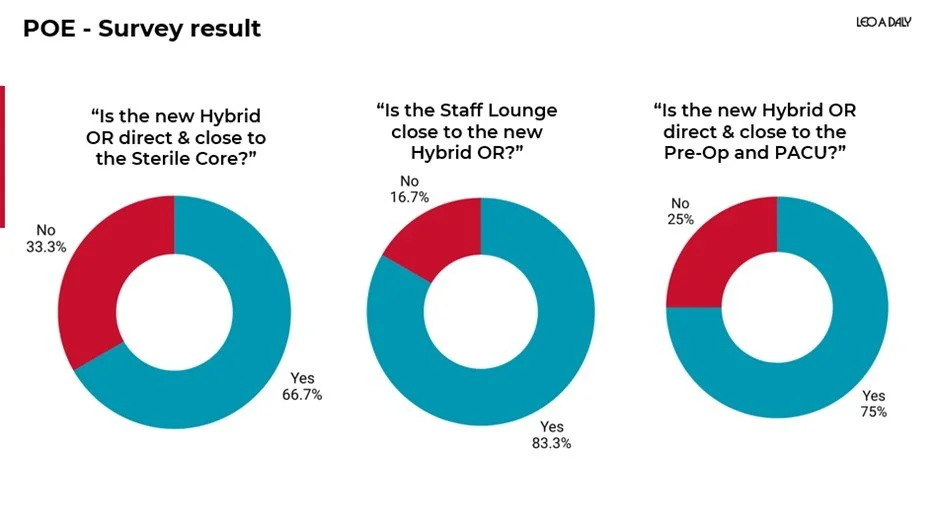
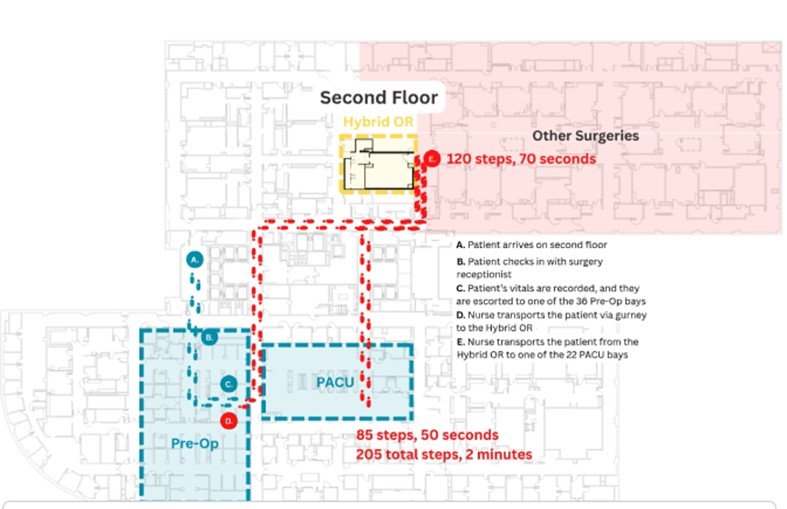
A follow-up detailed shadowing study showed an appropriate number of steps between the hybrid OR and the sterile core
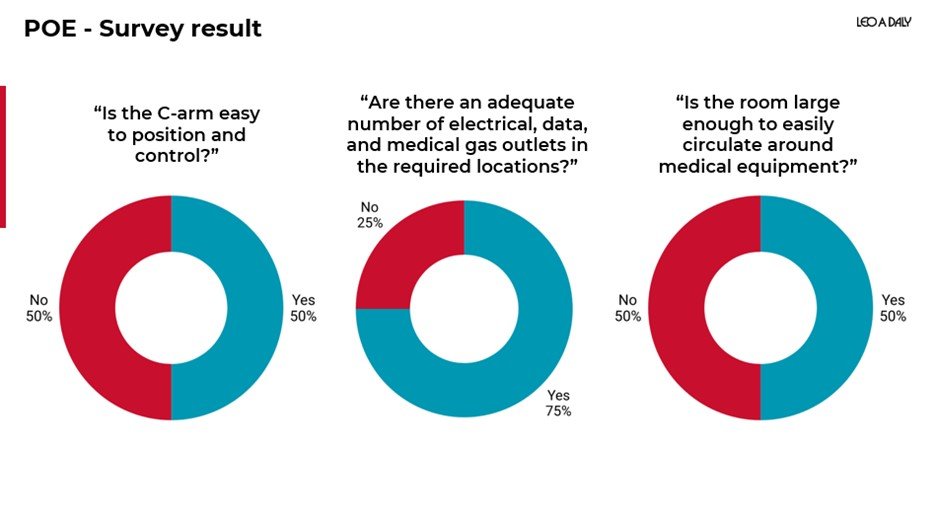
Survey findings also highlighted opportunities. Some users noted challenges maneuvering booms and positioning equipment, and several respondents felt the C-arm clearance at the foot of the patient could be improved. These results reinforce the importance of early coordination and ongoing refinement as hybrid OR technology evolves throughout the life of the project.
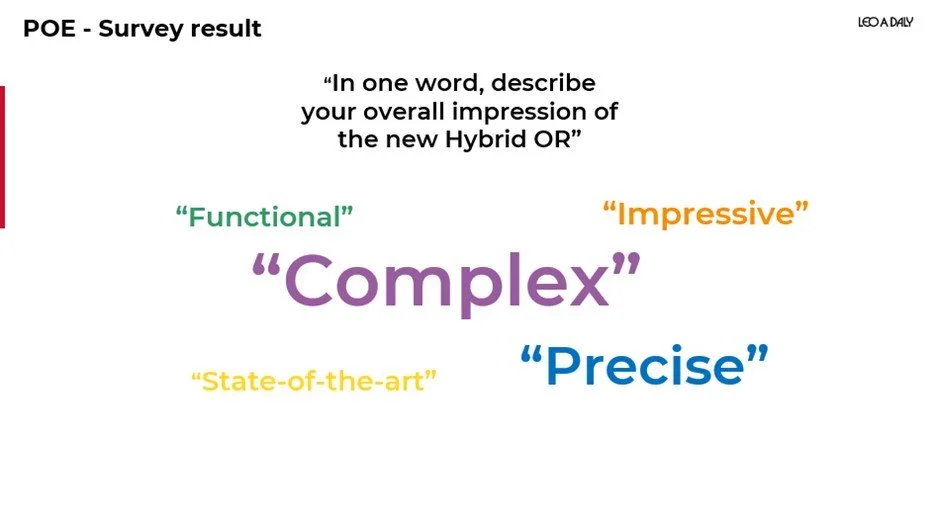
We ended the Survey with a choice of word to describe their overall impression of the new Hybrid OR. Overwhelmingly, the staff selected the word ‘Complex’ over other choices.
POE – Shadowing Pre-Op & Post Op
Shadowing the clinical workflow
Shadowing clinicians from pre-op to Hybrid OR for surgery and from there to post-op after surgery provided deeper insight into how staff moved back and forth between these zones during the working hours; counting the number of steps and the amount of travel time between these interdependent functional zones to determine efficiency and staff’s comfort. Our observations showed that adjacency of Hybrid OR to these support zones improved efficiency and comfort. The new Hybrid OR is well positioned within the surgical unit, and close to pre-op, post-op and sterile core areas in comparison to other similar large-scale hospitals, reducing the critical time moving a patient from one zone to the next and increasing staff comfort by reducing the number of daily steps. These insights help to inform how future hybrid ORs can better support staff and patient flows.
Clinical perspectives: what staff value most
Interviews added important context to the quantitative findings. Alan Arbolado, RN, Administrative Nurse for Vascular Surgery, shared his firsthand experience using the hybrid OR. He emphasized that workflow clarity, visibility into the control room by reducing the reflection on the control room glass window, and intuitive equipment placement directly support safer, faster procedures. His perspective underscored the value of engaging frontline users early and often throughout the design and construction processes.
Design learnings for future hybrid ORs
Panelists who participated in the POE presentation shared targeted recommendations for teams designing hybrid operating suites within active hospitals. Their insights centered on pre-planning, flexibility of the space and collaboration throughout the life of the project.
Key considerations included:
Engage all surgical teams in the decision-making process.
Understand above-ceiling constraints early.
Engage authorities having jurisdiction during preliminary review.
Keep vendors involved throughout the project.
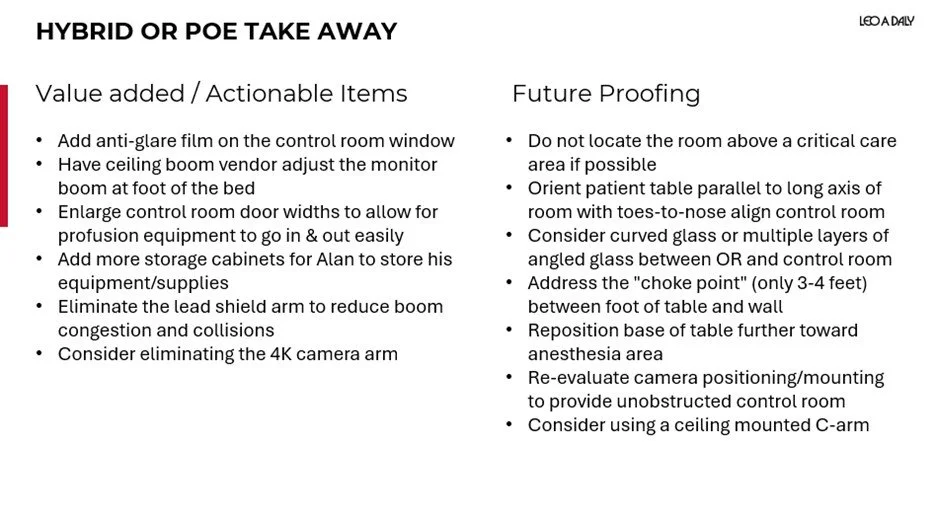
Maintain clear sightlines between the OR and control room by reducing glare
Do not assume the first layout is the final layout. Adjust by having mock-ups that would help the users to test the location of the equipment prior to permanent installation.
These learnings reinforce that successful hybrid ORs depend on continuous stakeholders’ engagement, coordination, research, simulation and evidence-based design refinement.
Looking ahead
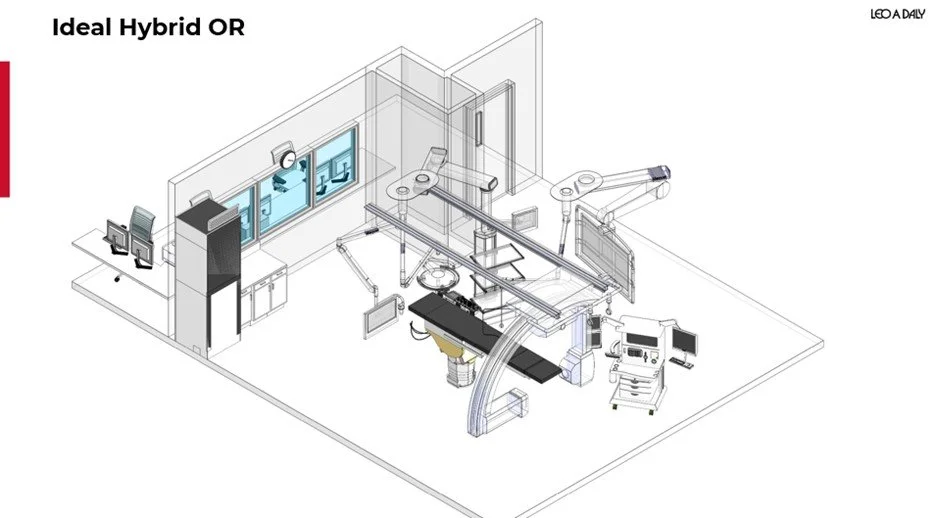
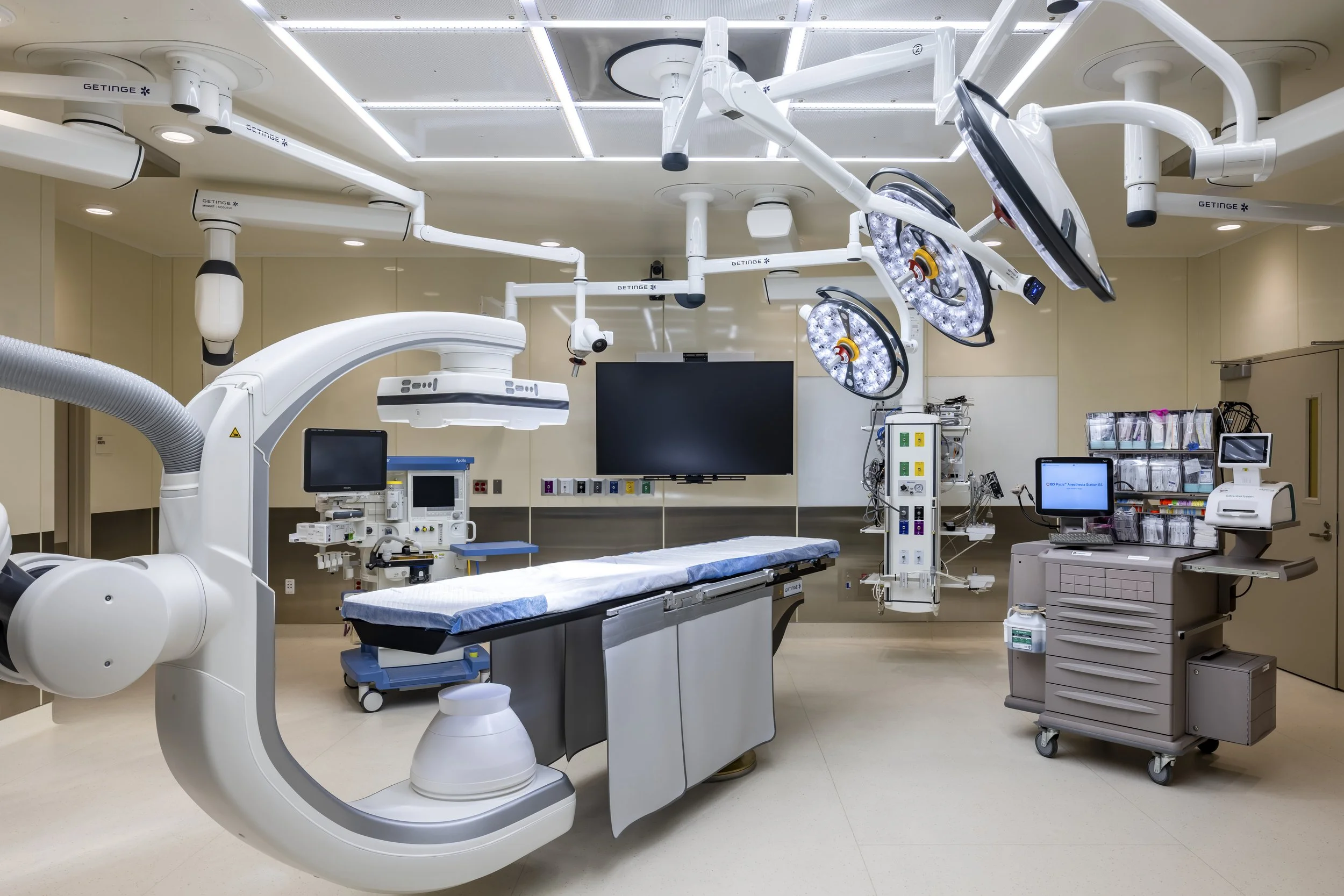
When asked to imagine the ideal hybrid OR of the future, panelists described a space that is flexible, intuitively organized and supported by technology that enhances clinical decision-making. Their responses emphasized adaptability, clear workflows and tools that strengthen precision and efficiency.
Value Added
Implementing a Post-Occupancy Evaluation (POE) provides a critical feedback loop that transforms building performance from theoretical design to practical excellence. By evaluating a facility after 6–12 months of use, clients can identify "low-hanging fruit" for immediate improvement and high-level strategies for future expansions.
Learn more about our Health & Wellness market sector.
About the author

Sarvine Ashkan, AIA, DBIA
Market Sector Leader – Health & Wellness
Sarvine Ashkan is a highly accomplished healthcare architect with extensive experience leading complex clinical design projects. Her work is driven by a commitment to improving patient and staff experience through thoughtful, efficient and research-informed / evidence-based design strategies. With deep technical knowledge and significant design-build experience, Sarvine leads multidisciplinary teams with clarity and purpose. Her expertise and leadership continue to shape high-performing, future-focused healthcare environments across the industry.